Friday, 24 May 2013

Uneasy Times On The Bay

     "I don't know how I'm gonna survive..."
                                  -Melissa Etheridge


      * Sorry about the gap in D6C installments- instead of simply typing outta my ass like usual, this post actually took real research and stuff.


     Water.

      Even if you aren't a boater, it fuels your life.  You drink it, bathe in it, cook with it, wash your dishes, your car and your dog with it, and some heathens use it to ruin perfectly good whiskey

     Without water, life ceases.

     With less water, life is possible, but less fun.

      Welcome to "less fun."

     Welcome to the 2013 Long Point Bay Boating Season, where and when we become acutely aware of the effects of events miles away and generations ago.

     I wanted to know what we are facing and why, so I did some research and learned some stuff.  I figured I'd pass along what I have learned.

     This year the Bay is caught in a perfect storm:  lower than usual water levels and high silt accumulation reducing water depth thanks to low precipitation, higher temperatures...and politics.


      Those of you following along at home know that water levels are a cause for concern down here on the Dock.  Boats need water to float, and sailboats, with their  keels sticking down to offset the force on the spars sticking up, need more water than most.
   
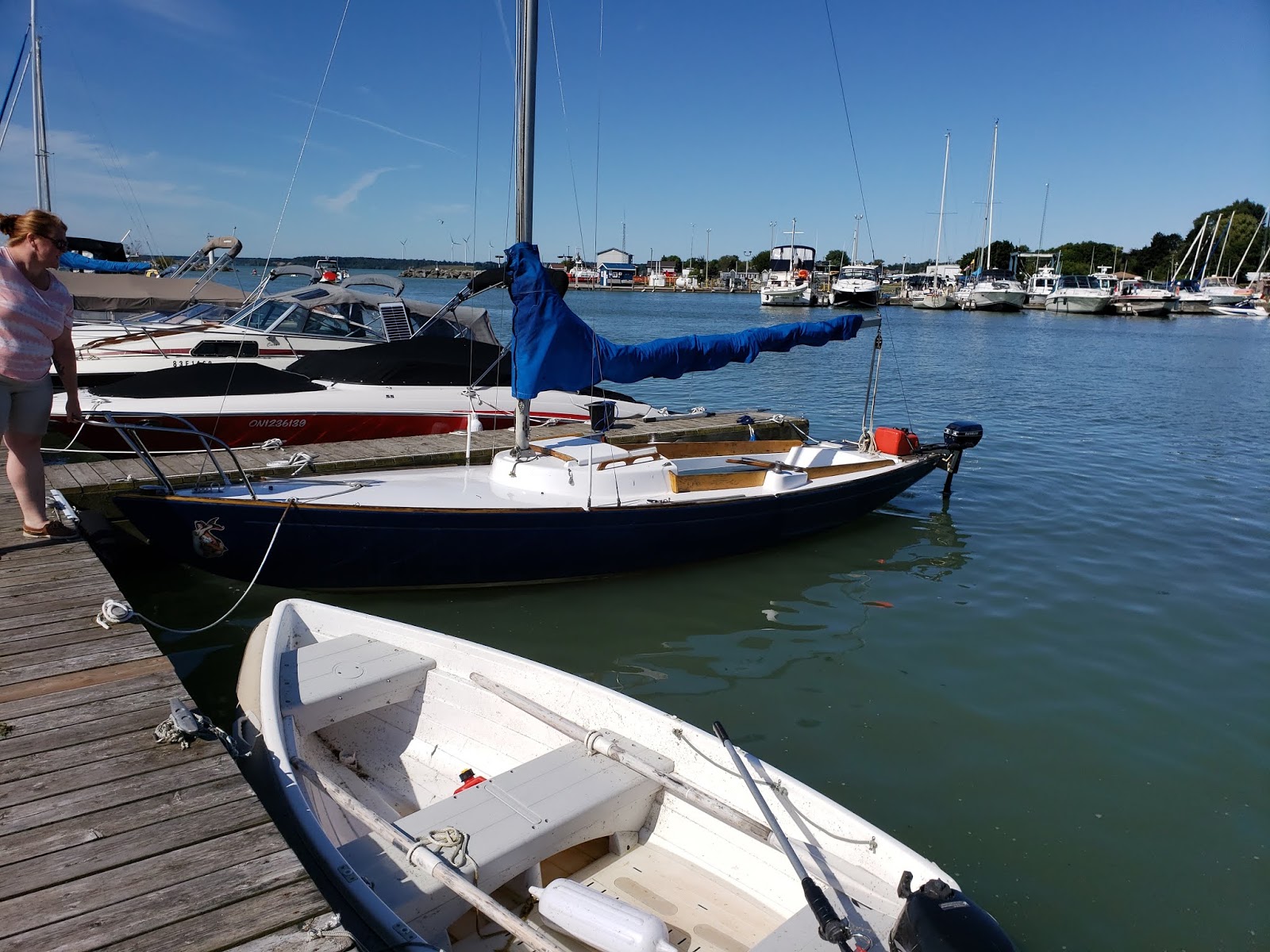
   Here was how the Dock looked in the Spring of 2011:


     Pretty much the same depth as the Fall of 2010- a relatively wet summer throughout the Great Lakes, and especially the Upper Lakes (Michigan, Huron, Superior)  helped bring up water levels throughout the season.

   The winter of  2011-2012 was dry - damn little precipitation, high temps virtually no ice on the lake,  yet  when the Dock opened in April, water levels were UP.


     Huh?

      I didn't understand the significance at the time.

       The spring of 2012 was short, hot and dry and the summer was long, hot and dry.

       This was the result:


        By mid-September the foot of the dock was high and dry thanks to a lack of precipitation throughout the entire Great Lakes region.  The first seven slips couldn't float a boat, and Will's Tanzer is nudged into the sand in the eighth slip out.

        I had never seen the water this low.


        So, where do we stand now?

      This winter was colder and wetter than last, locally, with more rain this spring, and here's how the Dock looked on Opening Day (April 15, 2013):


      Thankfully, up over last fall, better than Opening Day 2011, but about a foot shallower than Opening Day 2012.

     Okay, so what is going on?


     Historically, business as usual.

     Lake Erie is, essentially, a really, really big pond.  Erie is the shallowest of the Great Lakes, the farthest south, and has the smallest volume of water.... all of which has an impact on water level fluctuations.  The average depth is only 62 feet, and the deepest part of  the Lake is 210 feet, give or take.
 
     Long Point Bay is a little like a Mini-Me version of the Lake- maximum depth is  over 100 feet, but the vast majority of the Bay is closer to 20 feet.


                                                                                                   image courtesy of NOAA


    When the Upper Lakes enjoy a typical cold temperature / high snowfall winter, Erie's ownership of the "Shallowest Great Lake" and "Southernmost Great Lake" titles doesn't matter much.

    But, when inflow is reduced, it becomes crucial for the Lake to hold onto what she's given.  This is where that "Southernmost" part kicks in.  Erie doesn't get as cold as the other lakes, and as such usually freezes later, thaws sooner, and doesn't freeze as thick...
    When it freezes.
    The recent warmer winters have added insult to low-water injury.  The Lake hasn't frozen solid over the last few winters.
   
     "So?" Contrarian reader asks.

 So, no ice cap in the winter because of warmer temperatures means more water lost due to winter evaporation.

    Yeah, it turns out water doesn't just evaporate when it's hot.  It evaporates at any temperature above freezing, albeit at a slower rate.  So, instead of evaporating 8 months out of the year, the lake evaporates 12 months out of the year.

     Any evaporation is not a good thing in an already shallow Lake, and a shallower Bay. Increase the duration of the evaporation period by 50%?  Yeah,   not good.


   So, back to the geography:  Long  Point Bay is shallow.  Get into the Inner Bay, and it is much, much, shallower:


                                                                                    image courtesy of grand-experiences.com

           That's a lot of zeros on that chart.

           That's good for fishing and hunting and birding and hiking and kayaking and such because lots of fish and birds and turtles and other animals and trees and plants and such really like that shallow water, and that diversity is one of the reasons why Long Point is a World Biosphere Reserve.


          Much of the Inner Bay, at the best of times, is the depth of a suburban backyard swimming pool.
 
        (And not one of the nice ones, like you wish you had, growing up.    An above-ground pool.  A cheap one.  All shallow end.)

           These aren't the best of times, depth-wise.

           Here's the history:


                                                                                                 -graph courtesy of NOAA

                There's 150 years of average annual water level above sea level.  The red line is the average of the averages.
            Here's the current Data


      And here's how April 2013 stacks up against the historical record, according to the Canadian Hydrographic Service


Monthly Mean Water Levels
in metres referred to IGLD 1985
Niveau d'eau moyen mensuels
en metres par rapport au SRIGL 1985
April  2013  AvrilSuperior
Supérieur
HuronSt. Clair
Sainte-Claire
Erie
Érié
OntarioMontréal
Mean for Month (preliminary data)
Moyenne mensuelle (données préliminaires)
182.92175.75174.76174.0274.726.80
Mean for month last year
Moyenne mensuelle, l'année dernière
183.00176.03174.99174.3174.926.65
Mean for month, last 10 years
Moyenne mensuelle, 10 dernières années
183.06176.01174.94174.2474.927.10
Statistics for period of record
Statistiques pour la periode d'observation
1918-20121918-20121918-20121918-20121918-20121967-2012
Maximum monthly mean / year
Moyenne mensuelle maximale / année
183.68
1986
177.23
1986
175.82
1986
174.98
1985
75.65
1973
8.82
1976
Mean for month / Moyenne mensuelle183.26176.38175.04174.2274.887.44
Minimum monthly mean / year
Moyenne mensuelle minimale / année
182.72
1926
175.61
1964
174.32
1926
173.38
1934
74.03
1935
6.11
2003
Probable mean for next month
Moyenne probable du mois prochain
183.04175.92174.84174.1474.936.80
Chart Datum  /  Zéro des cartes183.20176.00174.40173.5074.205.55


    Right across the board- water levels are down from last year, below the average for the last 10 years and below the average for the last 95 years.

     In other words, if the water levels were Faber College grades, Dean Wormer would put  Lake Erie on double secret probation.

                                                       -courtesy of youtube & universal pictures


             Avid Reader, if your eyes haven't glazed over yet, and if you a contrarian skeptic, you are now pointing to the top graph and saying "It ain't as low as 1936! Or even 1962! Kwitcherbitchen!"

   Good point.

    Here's what's changed:

     The St. Clair River.

     Huh?

   
       The St. Clair River is the tie that binds the Upper Lakes (Michigan, Superior and Huron) to the Lower Lakes (Erie and Ontario.)  and sometimes that tie can be constricting.    The 60s were a booming time for manufacturing and agriculture in North America-  larger, deeper draft ships were needed to keep feeding the supply to the demand.

      Except they couldn't fit through the bottleneck of the St. Clair River.

       Solution?  Dredge the river.

      Yes, Constant Skeptic Smartypants Reader, I see you smirking.  Go ahead, say it.

       "Dredging is obviously GOOD NEWS for the Lower Lakes!   A deeper river means more water volume, and more water volume means less lake level fluctuation and the lake is consistently deeper, as borne out by the GLERL graph up there."

       Yep.  Absolutely right.

        Until the Upper Lakes suffer a drought...
   
         Like last year.

         Less water up there means less water down here..
And they have  a hell of a lot less water.

         The repeated dredging to keep the deep draft channel open, along  with sand and gravel mining has led to  "unexpected erosion"  according to a study commissioned in 2005. leading to:

    "...the [IJC estimating the ]drop in level difference between MH and E [Michigan, Huron and Erie- ed.] since
1860 is 36 to 46 cm (14 to 18 in.), compared to the actual observed drop of
approximately 80 cm (2.6 ft). Without implementation of compensation measures, this
drop represents an irreversible decline in the long-term average lake level of MH..."

   (More here for anybody suffering from insomnia:
http://pub.iugls.org/en/Other_Publications/Baird_Report.pdf  )


    How low did the Lake get in the mid 30s??  Down to 173.18 metres  (568 feet) above sea level, in February, 1936.

   In February 2013, Lake Erie hit 173.86 metres, (570 feet) above sea level.  Not quite sinking to a new low, but damn close.


     Take a look up there again at that Inner Bay chart- see all the depth marking starting with the number 0?  yep, less than a metre of depth at chart datum.  According to Real Time Water Level Gauging at Port Dover
   the Bay is currently hovering about .6 metre above  datum.
      Two feet.
 
      If the lake level drops to the level last seen in 1936, the Inner Bay is going to be nothing but a bigass puddle full of unhappy birds and fish and turtles and grasses and such.

   Low water levels have an impact upriver as well.  Here's  the channel abutting the Bridge Yachts yard:


     If that is where the water level is in the spring, by fall it's likely gonna be swampy.  Three seasons ago, every slip in the picture above was occupied.  In my conversations with canal-fronting homeowners this spring,  it sounds like most of those slips will likely remain vacant all season.


   "So,"  Impatient Reader sighs, " A lack of precipitation up there in the Upper Lakes coupled with warmer, dryer weather down here is having an impact on water levels and the St. Clair River dredging didn't help, but, the water is still above datum on the charts,  so what is the big deal?"

     This is where that "perfect storm" part I was talking about earlier comes in:

     It's not just that the water level is dropping...  the bottom is also coming UP.


    Let's go back to the low water days of 1936 for a second.  Here's one big local difference between then and now:
     Silver Lake.
     Essentially a millpond on steroids, Silver Lake was originally a power source for a woolen mill, and later a water source for the Ivey's greenhouse operation.

      Here's what it looked like back then:


  You can see Ivey's greenhouses and the powerhouse chimney in the background.

     Here's what it looks like today:

      It's dying.  The water level has dropped dramatically over the last few years.

  Here's why:


    Misner's Dam is picturesque...


  and on the verge of collapse.


  With the dam's stability in question, Norfolk County made the decision to drain Silver Lake, which, as so often happens, has caused some unintended consequences.
   Consequence #1:  In addition to it's intended roles in wool milling and plant growing, Silver Lake also served another purpose- it acted as a settling pond for sediment flowing down the Lynn River.  With the dam out of commission, the Lynn River has been flowing unimpeded, and the River downstream of the dam has started silting up.  Lower water levels and a rising bottom are forcing some unpleasant decisions.
       Dockage at the Port Dover Yacht Club  looks to be problematic... at least for now.

       From the newsletter:  "...Low water continues to plague us especially this year. We’re not sure what that means especially sail boats but power boats on the back channel could also be affected as well. Unfortunately we are beyond the point in time where dredging can occur..."

       Ouch.

     Consequence #2:   Apparently repairing a broken dam is no simple thing when two levels of government and bureaucracy are involved.  As it stands now, Ontario's  Ministry of Natural Resources  is demanding that any new dam being built must be constructed to withstand a "thousand year" flood, which means raising the surrounding land over 2 metres, with an attached price tag estimated to be north of ten millon dollars.

      (My suggestion, just fix it and fight the fines when the MNR comes calling, was roundly rejected.)

    Consequence #3:  Turns out not everybody wants the damn dam fixed.  Port Dover seems to be split between those who wish to save Silver Lake  and those who feel that repairing the dam is a blow to conservation, and this is an opportunity to return a manmade millpond back to it's natural state.

    Arguments are valid on both sides-  I wonder whether the value of a "naturalized" mill pond will be fully realized considering how developed the remainder of the Port Dover waterfront has become, or whether it will do more harm than good.


   Back at the turn of the century, this is what the harbour in Port Dover looked like:


   Minimal breakwalling,  lots of open banks, the Lynn River could flow out and the Lake could flow in as necessary during storms, largely unimpeded.

    Today:


The entirety of the Lynn River and Black Creek are breakwalled and narrowed.  Narrow inlets mean  outflow speed is increased, and inflow speed is increased as well...along with silt being driven in with every major storm.


   Silt and shifitng sand that was no big deal a decade ago is now an expensive problem.  A shallow harbour is a useless harbour, making dredging not just a matter of convenience, but an economic necessity.


   Sometimes dredging doesn't work out so well either.

      The Marina is being dredged, for the second time in five years.
   
   Right about there.

   Where the markers are.
   
   
    ...Marking where the backhoe sank.

    Read the tale here.


     Coming into the marina yesterday (yes, Whiskeyjack is finally in the water- more on that later) Rod Keegan and I marvelled at the depth at the mouth of the marina- or lack thereof.  Whiskeyjack's depth sounder measured a low of 6.4'.


     The solution?

      I don't know.

      Maybe  go into the prop repair business.

                                                                                        - image courtesy of Toronto Star


       We need some rain.

        Thanks to Jaye Lunsford , retired environmental scientist and liveaboard blogger extraordinaire, for her assistance in researching this post.  Any and all errors are the author's alone.


        "Talk the Dock!"


Tuesday, 14 May 2013

Book Reviewsday Tuesday: ASPOL, Y'all.

        "Mingle with the good people we meet..."
                           -Bob Marley and the Wailers


      I am a reader.

     Fiction, non-fiction, thrillers, romance, suspense, science fiction, horror, humour, the classics, high-brow, low-brow, I'll try it.

     But I might not finish it.

     Life is too short to invest time in an artless read.

    (When I hear someone pat themself on the back  for plowing through a boring doorstop of a book  they didn't enjoy, I mutter to myself,  "It isn't a badge of honour- it's a sign you need more life in your life.")

    (( Of course, it  could be argued that muttering to one's self about the empty accomplishments of others is a sign one needs more life in one's life.  It could  be argued.  Not that I would.))

      Sometimes, a book sneaks up on me.   I pick it up, certain I'm gonna toss the worthless waste of pulp back on the shelf before the first page is turned, and four hours later wonder why I hadn't read it sooner.

      "A Salty Piece of Land" is that kind of book.


      I was positive, absolutely sure, unwaveringly adamant that I would not like this book simply because of the author:

      Jimmy Buffett.

     See, here's the deal:  I can't stand his music.  It's like nursery rhymes for adults.

     So, my hopes were well and truly damped when I picked up this book in my local book store's remainder rack, and read the first line:
 
      "It all simply comes down to good guys and bad guys."

      Well, it doesn't suck so far.

       Within minutes I was well and truly stuck into the laid-back adventures of seafaring cowboy- on- the- run Tully Mars, Lost Boys fishing guides, the crew of the schooner Lucretia and the search for a Fresnel lens for a lighthouse in need of help.

        It's a book I re-read at least once a year, usually when winter is at it's deepest, darkest and coldest, when the Dock is farthest out of reach.

         ASPOL isn't Big L Literature.  It's never going to be taught in ivy-covered halls.  It's just a tale, told well enough, about characters that a reader can care about.

        And that's enough.

        If you can get past the Parrothead packaging you discover  that Buffett can write more than three- minute rhymes. There's not a whole lot of art on the page but there is a ton of heart.  He can set a scene and his dialogue may not always sing, but it doesn't clunk- it's obvious the man loves his characters and loves the settings and the adventures he tosses them into.   Yeah, it's occasionally far-fetched, yeah, some of the characters are thin on detail, thick on stereotype, so what?

      So are Hobbits and Hogwarts.

      Pick up a copy.  Toss it up on the bookshelf until the next rainy, miserable, holed-up kind of day.  Pour yourself a couple of fingers of rum, settle into your favourite chair, and get dug in.

      There are worse ways to spend a few hours.

       Like golf.


     "Talk The Dock!"


Thursday, 9 May 2013

Long-Term Gear (P)Review: Crocs. Huh, What?

     "You keep samin', when you should be changin'..."
                                            -Nancy Sinatra


         Like most sailors, I like to think of myself as a romantic traditionalist, carrying the torch passed down through generations of seafarers.

         SWMBO thinks I am a creature of habit, resistant to change.

         One of us is right.

         On very, very good days, it's even me.

         Take shoes, for example.

         Boat shoes, in particular.

         For decades I have worn Sperry Topsiders ™ in a variety of permutations- slip-ons, laced, leather uppers, canvas uppers, you name it.  They are solid, sturdy, dependable, shoes that all have a common set of characteristics:

        They always stink by the end of the first season.
        The soles always harden and get slippery by the end of the second season.
        They aren't cheap, even on sale.

         3 years ago, I rotated my latest pair of stinky, slippery Topsiders ™ into service as "boatwork shoes" and moved a new pair of West Marine Topsider-like shoes into regular use.  Same styling, slightly lower price....
       .... and same result- slippery as teflon covered-snot, and as stinky as bleu cheese aged in a diaper pail, by the end of the second season.

        So, they rotate into the "boat work shoes" slot and the Topsiders ™ rotate into "lawnmowing shoes" role.

       All of which means I need a new pair of boatkicks for this season.

       This time around, I decided that I might maybe, possibly, break with tradition.
     
        I knew what I wanted:
        Grip.
        Ventilation.
        Toe protection.
        Support.
        Comfort
        Durability

         Last season, I had the chance to check out a pair of Vibram Five Fingers ™.


    I liked the concept, but didn't like the lack of toe protection, and I like shoes that I can slip into with a quickness if necessary- these ain't that,  when you gotta make sure your piggies park in their own pocket.
  
And, although I rarely get invited to places that have a dress code, on the odd chance that an invitation to an event requiring a jacket is issued, deck shoes are acceptable, and mark one as a man of the sea-  Five Fingers™?  Er, maybe not so much.

   So, is there anything new that might meet my needs?

   Maybe.

  Meet my new Crocs ™  boat shoes: 


   Yeah, I know what you're saying. 

     I said the same thing.

   "Crocs?"
   "Crocs??? "
   "Crocs makes boat shoes?  Like, on-purpose boat shoes, not just I-wear-my-Crocs- on-my-boat shoes?"

    Yep, it turns out they do.  

   And the Crocs folks are so confident in the quality of their shoes, they sent SWMBO and I a pair of pairs to test this season.
    
           I ordered up a pair of  Cove Sports  while my better half opted for a pair of Above Decks.


When our new footwear arrived at Stately Jones Manor, the first impressions were largely positive.

      The stitching was nicely finished, the leather uppers were soft and supple and the shoes were light- the Cove Sports weigh about half  of what my previous boat shoes weigh.

     Do they meet the requirements, though?

     Ventilation?  Got it.

     Check out the scuppers on these bad boys:


     Water gets in, water gets out.  Air gets in, air gets out.    See the way the moulded sole wraps all the way around the side of the foot  and caps the toes?  Looks like it might be a toe-protection winner.  Big burly boaters don't cry- but jamming your toe on a cleat will make one's eyes water and cause the hurling of creative epithets to the world at large.

   Support?
   Comparing them side-by-each, it looks like the SWMBOs shoes have more support than mine:


  But, looks can sometimes be deceiving.  More on that later.

  One feature that I appreciate is that the removable insoles are all polymers.  No cloth, no glue, nothing that is going to come loose and end up polluting the lake or end up in the garbage... and one less "gets wet and stays wet" area.

    Both shoes have real-world usable "pull tabs" on the heels.  You can actually hook a finger in the tab loop to pull your shoes on.  Nice touch.

   Two minor gripes-  the laces. SWMBO finds the laces on her shoes to be kinda cheesy.  The laces on mine are kinda slippery looking.  More on that later, as well.

  Got grip?  Sure looks like it.  Nice tread pattern, good siping around the perimeter allowing water to
escape under each footfall.


  Okay, cool- first impressions are largely all good.

  So, let's put them to work.


   For the last 10 days, SWMBO and I have been wearing our new Crocs everywhere.  To work, to the marina, walking the dogs, riding our bikes, everydamnwhere.

    Initial impressions of these Crocs boat shoes under load?

   Better than expected, and in this traditionalist boat shoe-snob's view, far, far better than a pair of Crocs has any right to be.

     There has been no break-in period.  No blisters, no stretching, no issues- from the first day, it felt like I had been wearing them for years.
   
     They are WAY more supportive than they look.  I have been working some long days, on my feet for up to 12 hours at a time, and my feet don't hurt.  That is a Very Big Deal.  I have feet so flat that ducks go "damn!"  and the end of the day often finds me popping pain relievers and soaking my feet. (Yeah, middle age sucks.)  I have been foot-pain free for the last ten days.

      The initial grip is excellent.  Better than expected, which can take some getting used to, after shuffling around on slick soled shoes.  Will it last?  We'll see.

     The ventilation is great-  After taking these shoes off at the end of the aforementioned 12 hour workday, my shoes, and my feet, do not smell like the end of a 12 hour workday.

     They look good.  I've had people ask about them, and everyone is floored when SWMBO or I give up the maker.  The response is always the same:  "Those are Crocs?  Where can I get a pair of Crocs like those?"

      The laces are mildly annoying-  SWMBO thinks hers look cheesy but stay tied without getting stretched out or knotted, mine look better but need frequent retying.

     So far, neither pair is showing any noticeable wear.  On the dirt, they are doing the job they were hired to do.  However, one key component in this long term test is missing-

      These are BOAT shoes, and they have yet to do their thing aboard a BOAT.

    Will they  be up to the task to which they have been tasked?

     Will they  hold up over the long haul?

     Whiskeyjack splashes on May 15th.  Then, it gets serious.
 
     We'll keep you posted throughout the 2013 boating season.  If they work, we'll let you know.  If they don't, we'll let you know that as well.

      Meanwhile, it looks like the shoe roster has just added another player to the rotation:


   "Talk the Dock!"


Tuesday, 30 April 2013

Book Reviewsday Tuesday: "Under a Gypsy Moon" - Reflections and Revelations

   "Through the mirror of my mind...."
                        -The Supremes


    I once read somewhere that salt water has the power to heal , whether as sweat, tears, or the sea.

    This week's Reviewsday book  reminded me once again of the belief in the restorative power of the sea.


   Michael Hurley's Once Upon a Gypsy Moon  is, as described, a memoir.


  Here's what it's not:

   A travelogue.
   A tale of adventure.
   A tale of an "improbable voyage" as described on the cover blurb.


    Okay, stop me if this scenario sounds familiar:

     A sailor's marriage has hits the skids, his/her successful career has flamed out, his/her post-adolescent kids hate him/her,  his/her 50th birthday is in his wake,  She/he's feeling failure and the tap of fate's finger on his/her shoulder as he/she takes stock of his mortality and  contemplates that She/he is in the latter half of her/his life.

     This is when a sailor heeds the voice that has been calling to him/her since he/she first set foot on a boat, the voice that beckons one to cut the lines and sail over the horizon, to see what one can see and be what one can be. The voice that goes from beckoning to demanding:

     "If not now, when?"
    
       That sailor sets off to that fabled paradise known loosely as "The Islands".  Could be the Carribbean, could be the South Pacific, could be Mexico or Marathon Key.  All we know is, it ain't here, and neither is anything that the departing sailor needs or wants.  Maybe the sailor will find what he/she is looking for.  Maybe he/she will be back.
   Yeah, of course this is familiar- this drama plays out in every marina, on every shore, every year.

    It's hardly  "improbable."
   Hell,  it is a statistical certainty.

    It's only "improbable" to those with no connection to the water.

     "Once Upon a Gypsy Moon" is a collection of letters the author wrote to folks back home, lightly polished and edited and wrapped with a preface and an infuriatingly tragic final chapter.

    I can identify with a large portion of the author's backstory and his motivation  and his travails because, quite frankly, he is a jerk.

    And as a self-admitted semi-reformed jerk, I can spot another jerk.

    Which made the first two thirds of this book so damn hard to read.

    The author is unlikable.

    And, make no mistake, the author is where he is at the beginning of this memoir precisely because he is, indeed, a jerk.

   Think my description is too harsh?

   Here's the facts as the author lays them out in the first two chapters:

    He moved his family all over the country furthering his law career, always putting his aspirations first.
    He cheated on his wife.
    He got caught.
    His wife threw him out.
    He discarded the woman he cheated with, and is proud of that fact.
 

     What a great guy.  Unfortunately, the author doesn't quite get this.  He turns first to faith as the solution, apparently in the belief that a sinner is cleansed simply by showing up.  Not unexpectedly, the solution remains unfound.


     This man needs some saltwater redemption.

      Luckily, the author soon figures out that  he is a jerk, and he is not ashamed to let the reader know, and he admits that his ego, his pride and his selfishness were his downfall.

       So Hurley sets off aboard his anonymous 32 foot sailboat, Gypsy Moon, from the Magothy river in Maryland to points South, on a leisurely 2 year cruise...

       Which turns out to be about a 5 on the "Perils and Adventure" scale.

        His passages under sail,  (occasionally interrupted by flights back home), are largely uneventful, with the exception of maintenance issues directly related to the author's disdain for maintenance and stubborn disinterest in all things mechanical.


       As the author puts it:

             “True Salty Dogs- those self-sufficient Lords of the Deep who write books on navigation and the finer points of sail trim and boat mechanics- have long been a source of intimidation and annoyance to me.  As best as I can tell, there is not a poet among them.  They are math-science folk and engineering types all.  For them a clogged fuel line, battery overload, or electrical malfunction is a thing of rapture, and they set about solving the problem with a kind of Yankee ingenuity and determination “that built this country, by jiminy.”  For me, however, these malfunctions are all signs from a benevolent God that man was meant to sail across oceans by oil lamps, not motor across them with enough spare amps to power a refrigerator and a satellite weather station…” *

   So rather than join them, and become a self-sufficient "Salty Dog" himself, he'd rather beat them.  

   Not a good plan.  Mechanical and gear failures and the impact on the author's finances, timtetable and enjoyment of the ports visited are frequently explored topics.


        Along the way, somewhere about the Carolinas,  the author discovers online dating, and what starts as a verbose ship's log now becomes a love letter of sorts to a woman he woos with keyboard and , later meets...

   ...  and weds.
 
       The newlyweds continue the journey occasionally together, in fits and starts,the bride chronically seasick, the author occasionally flying home to build a new law firm, Gypsy Moon finally ending up in the Dominican Republic n the spring of 2011.

   Along the way the author may have found a redemption of sorts.  A great bulk of the book is taken up with spiritual  introspection and a great bulk of that introspection  is justification and rationalization and religion and the impact that all of it, and none of it, had on the author's life...

... Until  he came to grips with something that many of us have discovered:  a change in latitude does not cause a change in attitude.  If you were a jerk when you left home, you will be a jerk when you reach your destination, unless you commit to change.
 
    At which point, the book becomes an easier read- the author does a lot less hiding behind excuses and his quest for faith and grace, and focuses more on not screwing up and appreciating those around him.

     And only when you decide to stop being a jerk, will you find someone you love more than you love yourself, and someone who loves you right back.


     As a sailing odyssey, "Once Upon a Gypsy Moon" charts no new courses.  If you're looking for a well-written account of a journey through the eastern Caribbean or a cruising guide, this is not your book.

    If, on the other hand, you like a personal story of a man's firsthand account of his  journey to being a better man, this might be the book for you.


   * This passage stuck in my craw- I'm going to explore it further in a future blog post.


"Talk the Dock!"


Saturday, 27 April 2013

Gear and Tool Review: Short Money Hand-held VHF Radio

      "I'm on a wavelength far from home..."
                                  -Wall of Voodoo


    At the beginning of the 2009 season,   I  we figured  I  we needed a handheld VHF.  A handheld comes in, er, handy  for dinghy comms and shortrange comms from the cockpit, when dropping below to use the fixed mount radio in the cabin is inconvenient.

   So, in June of 2010, we I bought one.

   We  I bought a Uniden Atlantis 250 handheld VHF radio.

     Here's why:
 
     The fixed mount VHF on Whiskeyjack is a no-frills Uniden unit that is over a decade-and- a -half old and still going strong, the local chandler recommended the Uniden 250, and the radio seemed like it had everything   I  we needed, and nothig we didn't:  Rechargeable battery,  AC adapter and 12 v DC charger,  addtional battery mag to load AA batteries, 1w and 5w power, channel priority selection with a channel 9 panic button, belt clip... and a 2 year warranty.  At $95 and change it wasn't the cheapest radio, but it wasn't the most expensive either.  It appeared to be a decent value.


   My  our impression over the following two seasons is that it was a great radio.  It held a charge forever, had decent range and great sound...

    ...right up until the middle of July of 2012, when it suddenly had no sound at all.

   Which is decidedly ungood, since a radio that will not produce sound is no longer a radio, but a paperweight.

   The upside of this radio is it had a 3 year warranty.

   The downside of this radio is it only had a 3 year warranty.

    The chandler shrugged when I presented him with our my newly mute radio.  Our radio was rendered speechless one month past the warranty end date.

    ONE MONTH.

    So, we I now needed a new radio.

  (For those of you wondering about the strikeovers, let me clarify-  when good ideas succeed, they are a team effort, a collaboration between SWMBO and I.  When the poop hits the paddles, I'm on my own.)

    The new radio search sat on the backburner until the 2013 Toronto Boat Show, for reasons both economic and emotional.

   See, we I felt a little burned.

    We I did my job as a marine consumer.  We I didn't jump at the cheapest option, and I didn't dish out the dosh for all the bells and whistles that  I  we don't really need and will likely never use.  Instead we I was prudent and played it safe...

   and 37 months later we  I need to do it all over again.

    So, this time, I decided  I was going to go with my gut, and go low-buck.

    We I wanted the cheapest handheld VHF radio we I could find that had 5 watts of power, a rechargeable battery  with charger and a belt clip.

    (Actually, scratch the we part.  This time, I was on my own.)

     So, after investing some time in perusing the boats on display at the aptly named Boat Show, I made a beeline for the Radioworld booth.  I told the guy behind the counter what I needed, and a minute and $65 later, I walked away with a Midland Nautico 1 package.


  Here's what $65 got us:

   1w/5w Radio
   Rechargeable battery
   12 volt charger
    AC charger
    Storage bracket
    Belt clip
    Boom mic
    Waterproof storage bag
    Owner's Manual... thankfully.


      Our my initial impression is favourable. We I notice that the radio itself if smaller and lighter than the Uniden Atlantis, and the LED screen is about half the size...  and there is one fewer knob and one extra button than the Atlantis, and most other marine handhelds:
     What jumps out immediately is that there is no squelch knob. The Nautico has an "Auto Squelch" feature, which apparently kills static and background noise without having to dial it in manually.  This could be a cool feature... but it could also mean that weaker signals are lost.

     We'll see how it works in practice this season.
 
    I charged the battery, as per the owner's manual, on January 21.  To date, over 4 months of inactivity later, the radio is still holding a full charge...

...  I think.

  While this radio doesn't have a squelch knob, it also doesn't have a full time battery strength reading.  Instead, there is a "low battery icon" which appears on the LED screen when, as the description implies, the battery level is low, but one doesn't know the battery is low until the icon comes on. I kinda like the reassurance of knowing how much battery life I have, not just that I am almost out of juice.  This may not be a big deal in practice.  We'll see.

   As mentioned, while lacking a squelch knob, the Nautico does add a "Menu" button...

...  which makes things interesting.

   The "Menu"  button  is where the owner's manual becomes necessary.  Without it, this radio is barely functional.

    See, the upside of this radio's size is... it's size.

    The downside is that, with less real estate to display info, the LED screen cannot report on  all of the systems all of the time.  Thus, one has to learn how to navigate the menu to figure out how to access weather info, scan channels, set channel priorities, call tones, etc.  Upon perusing the menu, I discover that this radio has some cool features, if one can figure out how to use them by manipulating the "menu" button on it's own or in conjunction with other buttons, for example:

 -The option of traditional PTT (Push To Talk) communication or two Vox (hands free) settings.
- A "roger" beep at the end of each transmission
- 3 call-tone choices, to alert the user to incoming calls.
-A keypad lock, to prevent inadvertent setting changes.
-WX monitor, Channel Monitor and Channel Scan functions.
-Instant Channel 9 AND Instant Channel 16 buttons, when you absolutely, positively, need to reach out and touch someone NOW.
-A choice of high or low power settings.

   So, more features than the Atlantis, but less intuitive.  This radio is gonna require some homework to get the most out of it.


   Okay, so what is the deal with the form-fitting  bag included with this radio kit?

    According to Midland, this radio is water resistant.  In other words, you can likely use it in the rain or occasional spray-over-the-coamings conditions without issue, but if there is the possibility of submersion, like a dingy ride in choppy water, it behooves you to bag it.  The bag also addresses a shortcoming of the radio, whihc is that while there is a belt clip, there is no lanyard.  The bag has an attached lanyard, allowing one to hang the radio around one's neck whilst making a dingy run to the beach with the mutts.

   Along with being water resistant, this radio also does not float, which is another advantage to the baggie/lanyard combo:  Any air inside the bag adds some supplemental flotation, and a couple of floaty keychains snapped onto the lanyard will at least keep the radio floating long enough to grab it, if dropped overboard.

  I'm not sure of the value of the included boom mic/earpiece combo.  I wouldn't have paid extra for it, but, I didn't have to pay extra for it; it was included.  I'll try it.  If it works well, I can see some advantage in not having to give up  a hand to holding a radio mic button in a shorthanded situation.

 
I'll keep you posted on how this low-buck radio performs this season.  

 The key phrase here, as it so often is on the Dock,  is "low-buck."

  This is a short money radio, and the price point does have an impact on one's expectations.  If  I had invested $200plus in a radio I would expect submersibility and flotation and long term warranties and all the features easily accessible on an easy-to-read screen.

For less than the cost of dinner for 2 at The Keg?  I'm happy if it lasts through the 3 year warranty, and I don't mind having to study the owner's manual to figure out how to get a weather report.


"Talk the Dock"